- Feb 7, 2025
Why do we ask “Why”? The connection between autism, developmental disharmony and the need for understanding
- ~ Sabine Baeyens
- Trauma, Autism, Development, Sensory integration
- 2 comments
As someone on the autism spectrum, I’ve always had a strong need to understand the “why” behind everything. I remember watching my children do the same - constantly asking “why” about the world around them - and it made perfect sense to me. Many autistic individuals share this deep, almost instinctive drive for explanations that goes far beyond simple curiosity. But why is that?
The answer lies in something that doesn’t get talked about enough: the disharmonic developmental profile common in autism.
Why learning from mistakes works differently for autistic people
A challenge many autistics face is struggling to learn from mistakes in the way neurotypicals do. It’s not that we don’t want to - it’s that our developmental path doesn’t follow the same trajectory. For neurotypicals, making a mistake often leads to an automatic adjustment in behaviour. For us autistics, that process isn’t as straightforward.
This isn’t about being stubborn or lacking intelligence. It stems from a fragmented developmental pattern, where skills and experiences don’t always integrate seamlessly. Instead of forming a smooth learning curve, autistic development is often scattered - some milestones are met, others are delayed, and some never fully develop. As a result, lessons from past experiences don’t always get absorbed in a way that allows for immediate change.
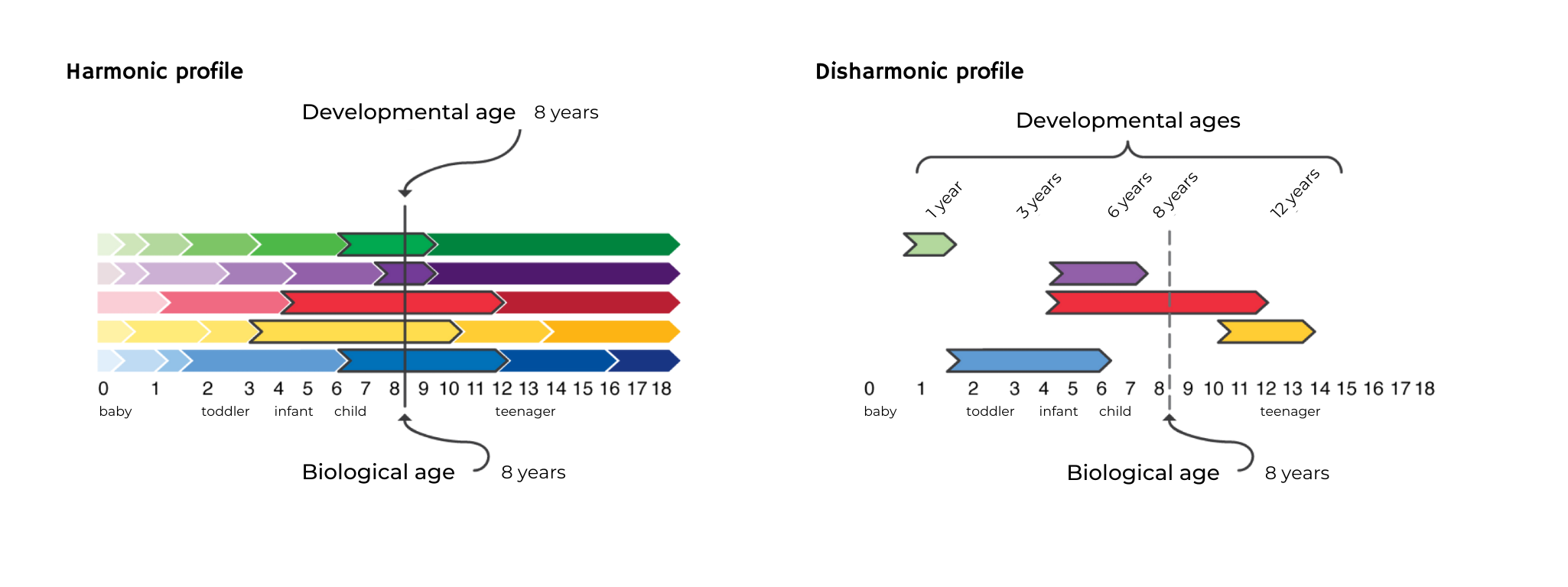
The role of sensory processing in developmental disharmony
All autistic individuals experience sensory processing differences to some degree, with hyper- or hyposensitivity playing a core role. These challenges can create gaps in development, leading to struggles that persist into adulthood.
For example:
A child with proprioceptive difficulties (trouble sensing their body’s position) may struggle with movement-based learning, impacting body awareness and coordination.
A child with auditory processing challenges might miss out on the natural rhythm of conversations, leading to difficulties in understanding social cause-and-effect.
A child who is tactile-sensitive may avoid touch, making it harder for parents to soothe them through physical comfort. Instead, they may rely on visual aids like pictograms, which, while useful, don’t provide the same emotional reassurance as a loving hug.
These sensory challenges don’t just delay development - they create gaps that don’t necessarily close with time. The brain ends up storing experiences as isolated chunks rather than forming a cohesive, connected learning framework. This makes generalisation - applying past lessons to new situations - so much harder.
Seeing the world in black and white
A well-known trait in autism is binary thinking - viewing things as either “good” or “bad,” “right” or “wrong.” But this isn’t simply a personality trait - it’s a response to developmental disharmony.
When the nervous system is constantly in survival mode, the brain seeks to simplify information into clear-cut categories. Grey areas require more cognitive effort, and for an overwhelmed nervous system, that extra processing power just isn’t available.
This survival state is triggered by:
Ongoing sensory overload
The unpredictability of life
Unprocessed trauma
Autistic individuals navigate a world that feels overwhelming and unpredictable, so rigid categorisation becomes a coping mechanism. This is where the persistent “why” questions come in - we need to analyse and categorise our experiences logically to make sense of them. It’s not just curiosity; it’s a way of ensuring safety in an often confusing world.
Why do we ruminate?
Many autistic individuals experience rumination - going over the same thoughts, conversations or mistakes again and again. We replay interactions, wondering what we did wrong or how we could have handled them differently.
This, too, is tied to developmental disharmony. Because our learning process isn’t linear, we don’t always absorb lessons from our experiences the first time around. Instead, we have to process, analyse and categorise everything - sometimes multiple times - before we can truly integrate knowledge and move forward.
It’s like trying to put together a puzzle when half the pieces are missing. Our brains work overtime to fill in the gaps, which leads to those endless mental loops and repeated “why” questions.
Recognising developmental disharmony in autistic children
If you work with autistic children, it may be helpful to assess whether a child has a disharmonic developmental profile. Here’s a resource that helps check which developmental milestones are commonly at risk of being skipped or only partially developed in autism. Identifying these gaps early can help guide the right kind of sensory intervention.
Final thoughts
So, why do autistic people ask “Why”? Because our brains are wired differently. Because our learning process is fragmented. Because in a world that feels overwhelming, categorisation provides a sense of safety and stability.
The “why” isn’t just about curiosity - it’s about survival. And as we work toward sensory healing, we may find that the need to ask why begins to lessen. We get to rely more on our bodily sensations and the world becomes a little more predictable, a little more understandable, and - most importantly - a little safer.
Have you noticed this pattern in the children you work with? Do you experience the “why” loop yourself? Let’s start a conversation!
2 comments
Thank you Sabine, for this information. I don't have the experience yet with children with autism. With neurotypical children the the "why" questioning usually starts around the age of 2,5 till 5/6 years old. To my understanding it helps the development of the brain in creating new neuro pathways. It also build confidence in them selfs. Often we get the recommendation to return the question, buy asking What do think?. Would that be wise for children with an autistic pattern?
Great question, Martine thank you.
You’re absolutely right that for neurotypical children, asking why is a natural part of their cognitive and emotional development, and in many cases, reflecting the question back “What do you think?” can encourage independent thinking and problem-solving.
With autistic children, however, the why-question often serves a very different function. Rather than being purely exploratory, it is mostly a coping mechanism - an attempt to find certainty and establish safety.
Because of this, simply turning the question back on them is not always helpful. Knowing that asking why is a coping mechanism for autistic children, it would be better to focus on addressing the underlying need rather than simply reflecting the question back. When an autistic child repeatedly asks why, it usually means something is missing. It’s up to us to figure out they are lacking.
Is there a lack of clarity?
do they genuinely not understand something?
Is there a lack of predictability? are they trying to create order in an overwhelming situation?
Is there a lack of support? do they feel alone in processing what’s happening?
Is there a lack of energy or capacity? are they too tired or overwhelmed to handle a situation?
Instead of turning the question around and asking “What do you think?”, which might work well for neurotypical children, it’s often more effective to directly meet the need.
Autistic children don’t usually ask why for the sake of exploration; they ask because they are searching for stability and safety. Remember that they have trouble learning from earlier mistakes. Giving clear, concrete answers or adjusting the environment annd providing more support will often be more effective than encouraging reflection.
That being said, some autistic children do enjoy thinking things through if they are in a regulated state. In those cases, asking “What do you think?” could work - but only if they have the cognitive, emotional and energetic capacity to engage with that kind of reasoning. If they seem stuck in a loop, it’s usually a sign that they need a clearer answer, more support or just need to rest.
I hope this helps 🙂
Sabine